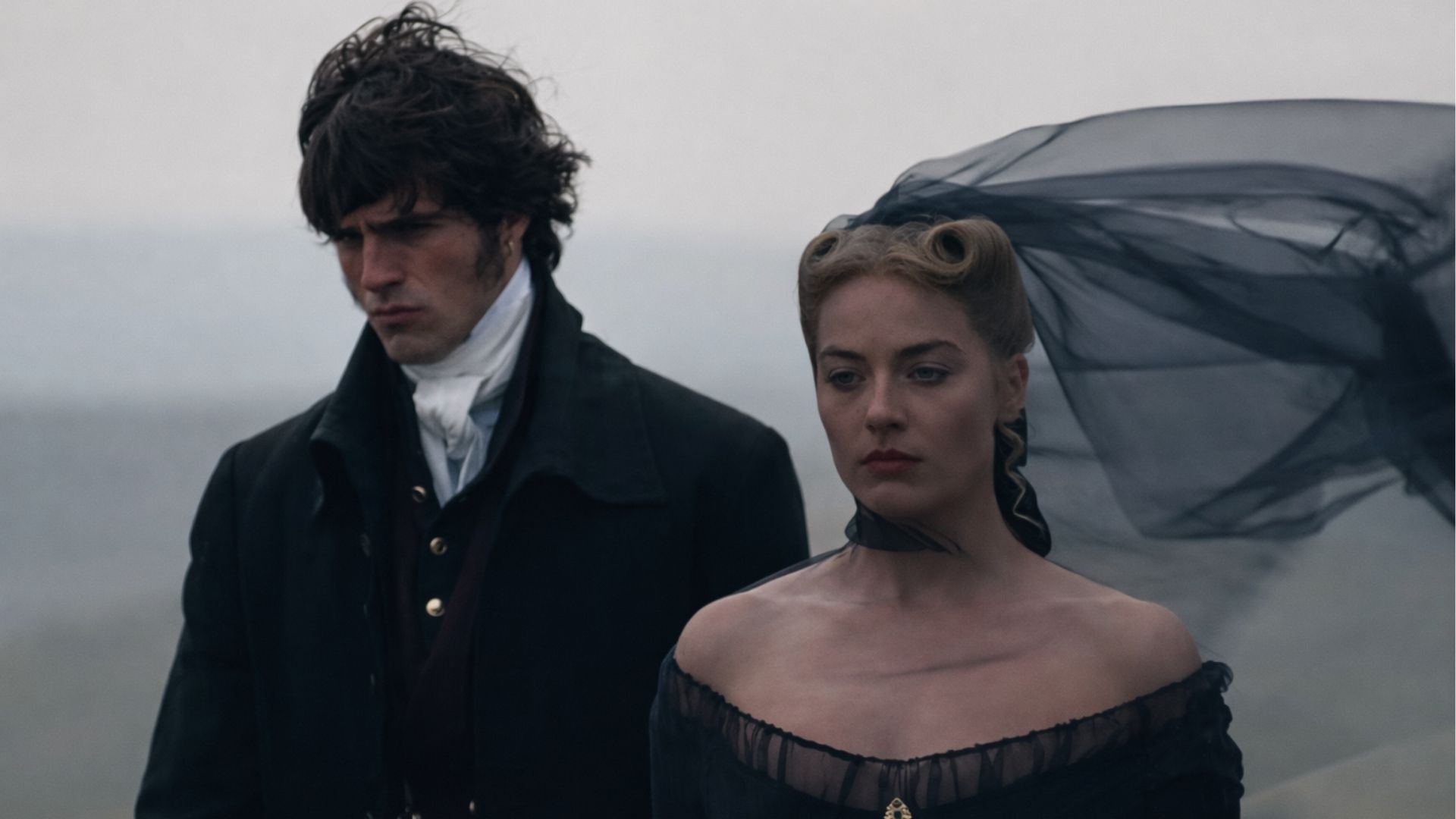
The 2026 science fiction drama In the Blink of an Eye uses three different time periods to show how people maintain their core human traits, which include their ability to survive and endure loss while they build their personal legacies. The film, which Andrew Stanton directs after his success with Finding Nemo and WALL-E, showcases Rashida Jones, who plays the present-day anthropologist Claire; Daveed Diggs, who plays her partner Greg; Kate McKinnon, who plays Coakley, the future space pilot; and Tanaya Beatty and Jorge Vargas, who portray prehistoric Neanderthals Hera and Thorn.
The story starts roughly 47,000 years ago, which shows a family dealing with basic survival needs, and it moves through 2025, which shows two people managing their relationship through their period of mourning, and it ends in 2417, when humans search for fresh beginnings on an alien world.
The movie uses minor links between characters to show how their actions affect others throughout thousands of years while showing the continuous pattern between life and death. The film, which appeared at the Sundance Film Festival before its February 27, 2026, release date on Hulu, shows a dual historical and futuristic dramatic story that subscribers can stream exclusively on the platform.
In the Blink of an Eye: The prehistoric tale: Survival 47,000 Years Ago

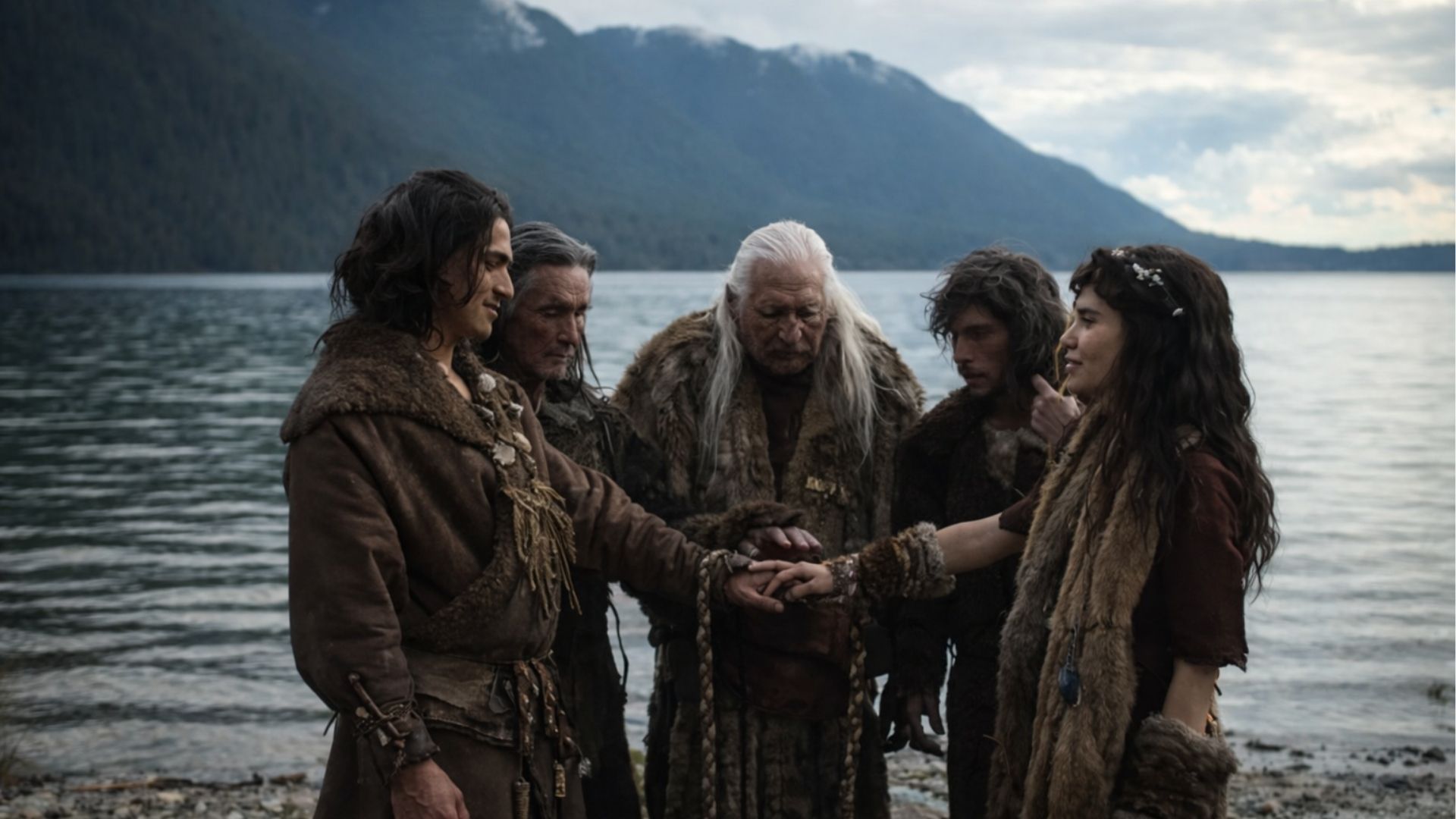
The first storyline of In the Blink of an Eye takes place roughly 47,000 years ago and follows a Neanderthal family struggling to survive. Thorn suffers severe internal bleeding after an accident while searching for food, but Hera cares for him, and he eventually recovers. Hera, his wife, provides him with minimal treatment while she gives him an acorn pendant, which represents his ability to overcome challenges during his healing process.
The family faces another tragedy. After another child is born, Hera later dies from complications, leaving Thorn and the children to continue without her. Thorn and Lark, who is his remaining daughter, start their life as wandering exiles until they meet a Homo sapiens tribe who bring them into their group. The meeting with the Homo sapiens tribe becomes an important turning point, as it connects Thorn and Lark’s family line with the future of humanity.
The acorn, which starts as a basic object, transforms into an ancestral treasure that represents everlasting existence which continues despite the constant dangers of extinction. This segment shows how people instinctively form family connections while they learn to adapt to situations that arise because it uses visual storytelling to show basic human difficulties without using present-day spoken language.
The modern narrative: Love and loss in 2025

The film In the Blink of an Eye progresses to its modern time period when Claire, an anthropologist, examines prehistoric human remains and discovers a skeleton wearing an acorn pendant. The discovery eventually becomes one of the key links connecting the film’s three timelines. Claire’s personal life intertwines with her work as she begins a relationship with Greg, a statistics professor. Their bond deepens as Claire learns that her mother has terminal cancer, prompting her to leave her job and return to Canada.
She keeps her long-distance relationship with Greg while feeling alone, which develops into their marriage and their journey to parenthood. The couple experiences sorrow after the mother’s death, but they find comfort through their process of creating a family together. Greg transforms the acorn from Claire’s lab into a family heirloom, which they give to their son David.
The timeline of In the Blink of an Eye shows how people experience daily life through their work demands and their romantic relationships, and their ways of dealing with disease, while showing how personal artifacts like the acorn retain emotional significance, which leads to future developments.
In the Blink of an Eye: The futuristic journey: Humanity’s last hope in 2417

In the Blink of an Eye, the futuristic storyline takes place in 2417 and follows Coakley, who has received genetic enhancements and lives for an extended period as she conducts her mission to deliver human embryos aboard her spacecraft to the planet Kepler-16b.
When a disease infects the greenhouse plants that produce oxygen, Coakley faces a crisis that threatens the entire mission. ROSCO eventually sacrifices itself by shutting down so the remaining resources can be used to keep Coakley alive. She successfully uses artificial wombs to deliver her first four embryos after multiple failures until her child V becomes her assistant. Coakley leads the development of new human societies which she establishes during her travels.
The acorn from the past has transformed into a golden relic that serves as her companion because it represents human history. The story explores Coakley’s isolation and the sacrifices she makes to preserve humanity’s future.
Unravelling the connections: The Acorn’s journey

The acorn serves as a recurring element throughout the movie, which connects different time periods to show how families maintain their bonds across different generations. The acorn begins when Hera gives it to Thorn after he survives his injury. Thousands of years later, Claire discovers the pendant with prehistoric remains. The ending suggests the skeleton belongs to a descendant of Thorn and Hera, linking the object to their family line. Greg transforms the acorn into a golden family heirloom, which he and Claire eventually give to their son David.
Claire and Greg’s son David grows up to develop Elixir, a technology that dramatically extends human life. That breakthrough eventually makes Coakley’s centuries-long mission possible. Coakley receives the acorn, which she takes to Kepler-16b, where she gives it to V, who is the first child born in space.
The chain demonstrates how small actions and things lead to major results, which include evolutionary development during prehistory and the development of technology that keeps humanity alive. The connections show a spiritual network that connects personal distress across time because people experience loss during one time period, but their pain drives progress in another time period. Individual human experiences build a shared heritage because people do not realize their role in the collective heritage.
Decoding the ending In the Blink of an Eye: Renewal in a New World
The climax of In the Blink of an Eye takes place on Kepler-16b, which Coakley uses as her landing point after hundreds of years of space travel to reach an Earth-like environment that she shares with the new generations of humans. Decades later, Coakley attends V’s funeral, having outlived him because of her enhanced lifespan.
Coakley had previously feared becoming the last human alive, but V’s funeral shows her that humanity has continued through multiple generations. The acorn, which remains connected to the family’s history, represents continuity across generations. This brings forth hope in the face of human death. The film ends on a positive note by showing how humans successfully adapt to their new planet, which allows them to establish connections with one another.
The resolution shows that humans discover meaning in their existence through the limited time they have because eternal life would result in people losing their drive to progress, yet death brings about fresh beginnings. The three realities merge into a single story about human endurance, which demonstrates that the human spirit survives through time because people inherit resilience from one another.
Also Read: Inside Netflix’s War Machine: Plot, cast, release date, and everything we know
Follow us on Instagram and Twitter.

Hilfa, Senior Writer at Hilvaro, excels in pop culture journalism. She crafts engaging content on movies, TV, & trends, fueled by her love for storytelling & entertainment.
Discover more from Hilvaro
Subscribe to get the latest posts sent to your email.